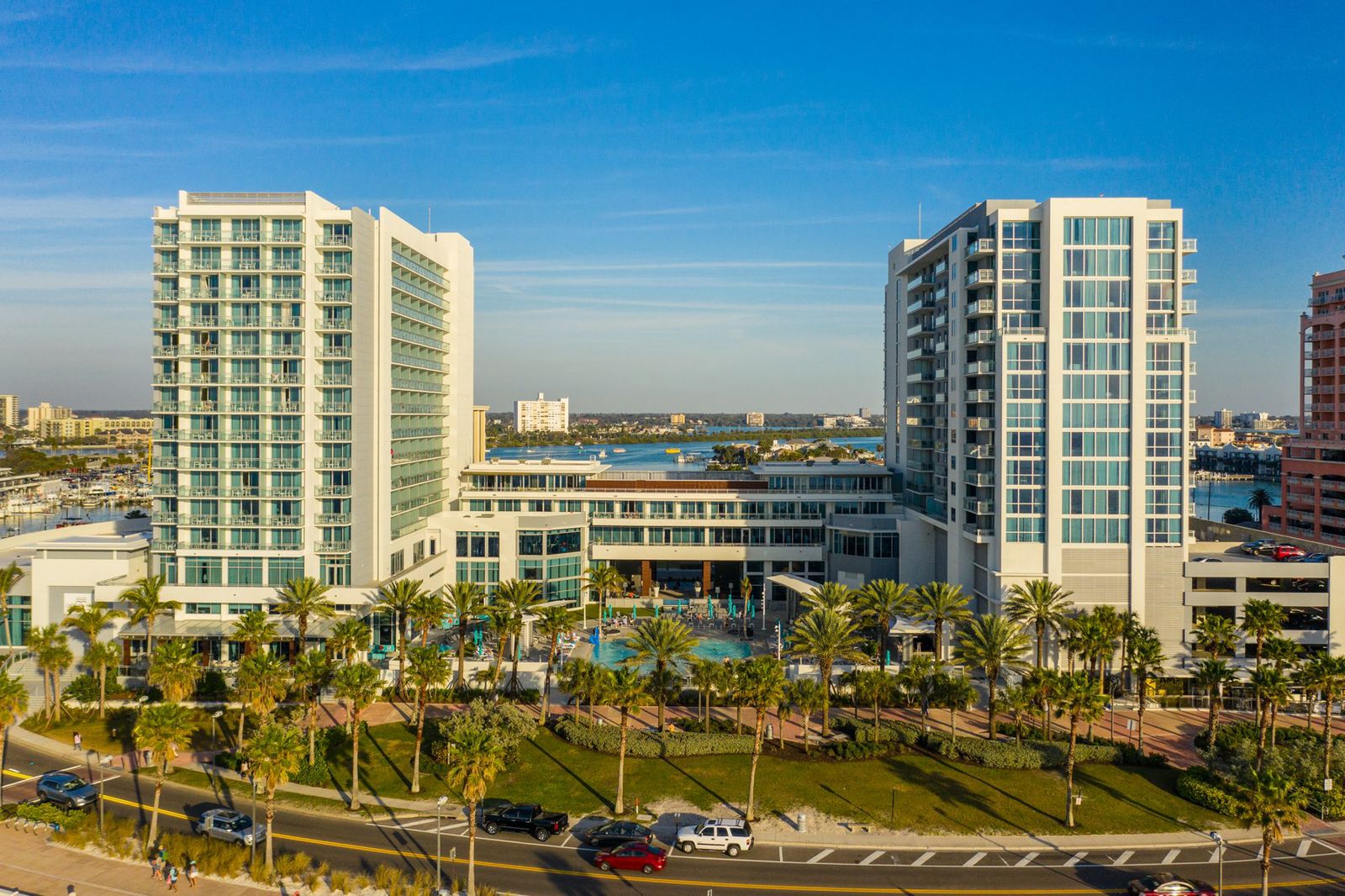
The photograph above shows a beachfront resort hotel in late afternoon light: two guest towers in pale stucco and glass, a palm lined entry drive running along the front of the property, a pool deck tucked into the courtyard between the wings, and the intracoastal waterway opening up behind the buildings. It was made from an elevated position, high enough to clear the palm canopy and read the full footprint of the resort in one frame, low enough that the property still feels like somewhere you walk into rather than a site plan.
That balance is the whole assignment. A resort exterior has to identify the property, establish where it sits, and imply what a stay there feels like, all before a prospective guest has read a single word of copy. Get it right and the rest of the gallery has something to live up to. Get it wrong and you have a competent picture of a building that could be anywhere in Florida.
Why the Exterior Hero Carries the Most Weight
Interior frames sell rooms. Amenity frames sell features. The exterior is the only image that sells the property as a place, and it is almost always the first thing a guest sees, whether on the hotel's own site, an OTA listing, a brand page, or a developer's investor deck. It is also the frame that gets cropped hardest, so it has to survive a 16:9 hero band, a square social tile, and a narrow mobile header without losing its subject.
Hospitality clients feel this intuitively but describe it loosely. They ask for a shot that looks inviting. What they mean, in practice, is a frame where the architecture reads cleanly, the water or the beach is visible, the landscaping looks maintained, and nothing in the scene suggests the property is under construction, empty, or tired.
Choosing the Elevation That Reads the Property Correctly
Ground level rarely works on a beachfront resort. Mature palms, the entry drive, porte cocheres, and the parking structure all sit between the camera and the building. From the sidewalk you get foreground clutter and a compressed slice of one tower. The property loses its scale and its relationship to the water disappears entirely.
A top down aerial fails for the opposite reason. Straight down, a resort becomes a diagram: roof membranes, mechanical units, and a blue rectangle where the pool is. Nobody books a stay from a roof plan.
The productive band sits between roughly 80 and 200 feet, angled down modestly, with the camera positioned so the two towers separate rather than overlap. From there the pool courtyard stays visible, the palms read as landscaping instead of an obstruction, and the water behind the property does the work of establishing location. That is the height the photograph above was made from, and it is the first thing to solve on any resort exterior before worrying about light.
Timing Light on a Coastal Property
Florida beachfront hotels are usually oriented toward the water, which means the good facade and the good background are often lit at opposite ends of the day. Sorting that out before the shoot is worth more than any amount of editing afterward.
A few timing rules hold up consistently on these properties:
- Mid to late afternoon gives glass a warm tone and keeps the sky saturated without blowing out the white stucco that dominates most coastal resorts.
- Overcast is workable for detail but flattens the water, which is usually the single strongest selling point in the frame.
- High noon is the one condition to refuse outright; vertical light kills the modeling on the towers and turns the pool deck into glare.
- Twilight is a separate deliverable, not a substitute for the daytime hero. Both belong in a full hospitality set.
On a property this size, the usable window for the main exterior is often 40 minutes. Scouting the day before, or at minimum arriving two hours early, is what makes that window productive instead of frantic.
What to Check on the Ground Before Launching
Resort exteriors fail on details that have nothing to do with photography. Before the first frame, walk the property and confirm the following:
- Pool furniture is squared, umbrellas are open and uniform, and towels are stocked rather than piled.
- Service vehicles, dumpsters, and staff parking are moved out of the frame or screened by landscaping.
- Landscape lighting and architectural uplighting are switched on if a twilight frame is planned for the same session.
- Balcony doors and blinds are consistent across the tower faces; a random pattern of open and closed reads as neglect at a distance.
- Flags, banners, and construction signage are either intentional or removed, since a limp flag is a permanent date stamp on an image.
Ten minutes of this coordination with the property manager saves hours of retouching and produces a more honest photograph than any amount of cloning.
Building the Set the Client Actually Needs
One hero image is never the deliverable. A hospitality exterior set that earns its keep usually includes the wide establishing frame, a tighter architectural frame on the entry and porte cochere, the pool courtyard from the elevation, a water side view showing the property in its coastal context, and a twilight version of the primary angle. Together those cover the website hero, the OTA gallery, the brand submission, and the sales and marketing collateral, which are four audiences with genuinely different needs.
Shooting for all four in one session is a planning problem more than a technical one. The property gives you one afternoon, one sky, and one state of readiness, so the order of operations matters as much as the exposures.
The exterior is the promise. Everything else in the gallery is the proof. If the promise is vague, guests never get far enough to see the proof.
That is why a resort exterior deserves more preparation than it usually gets. It is not a record of a building. It is the frame that decides whether someone keeps scrolling or starts checking dates.
If you are marketing a hotel, resort, or coastal hospitality property in Florida and the exterior imagery is not doing that work, get in touch to talk through the shoot. I photograph hospitality, architectural, and commercial properties across the state, and the exterior set is where most of these projects should start.