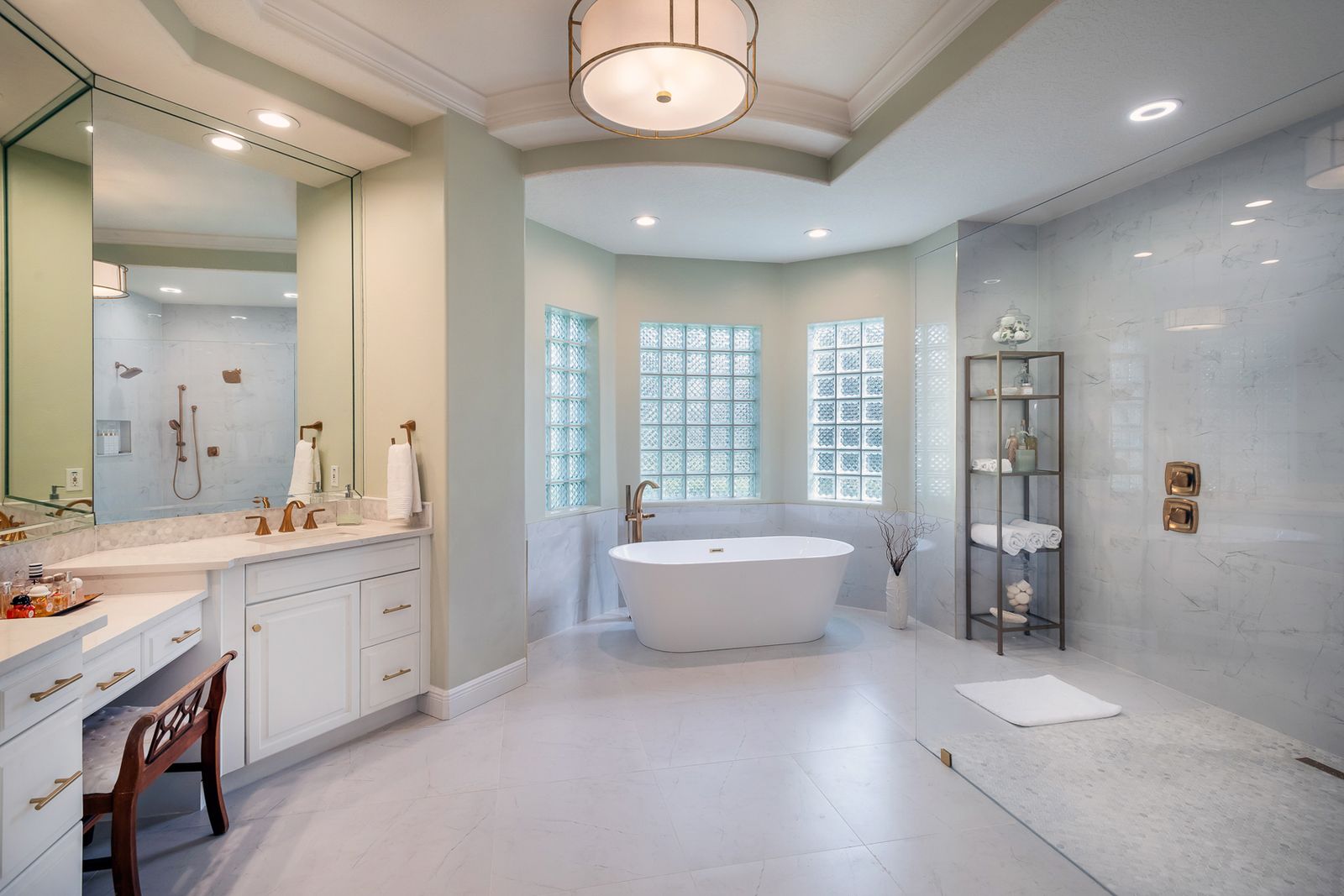
The bathroom in the photograph above is a Florida master suite built around a freestanding soaking tub, set into a curved bay of glass block, with a marble walk-in shower behind frameless glass and a long vanity run finished in brushed bronze. It is a beautiful room. It is also a room that fights back the entire time you are working in it, because almost every surface in the frame is reflective, white, or both.
Master bathrooms are among the hardest spaces in a luxury property to photograph well, and among the most closely studied once the gallery goes live. Buyers linger on them. Designers submit them to award programs. The difficulty is structural rather than artistic: the room is small, the mirrors face each other, the stone bounces light in directions nobody planned, and there is almost nowhere to stand that a mirror cannot see. Here is how I work a room like this one.
Mirrors Decide Where You Stand
In most rooms, camera position is a creative decision. In a bathroom, it is a constraint problem you solve before making any creative choices at all. In this frame there is a full wall mirror above the vanity on the left and a floor to ceiling glass shower panel on the right. Both see the room, which means both can see me. Working the reflections first, before touching a light, is what keeps a shot like this out of hours of retouching.
- Set the tripod, then check every reflective surface in live view before you light anything.
- Shoot from outside the mirror angle rather than square to the vanity, so the glass returns the room instead of the camera.
- Use a door frame or a wall return as cover. A body half hidden behind an architectural edge is far easier to clean up than one floating in open mirror.
- Lower the tripod. Camera reflections usually sit between chest and eye height, and dropping the lens six to twelve inches often moves you out of the mirror completely.
- When a reflection is truly unavoidable, plan for it: shoot a clean plate from a shifted position and blend the two frames rather than cloning by hand.
Marble Behaves Like a Light Source, Not Like Stone
Polished marble does not sit still. It picks up whatever is near it and returns a version of it, so a white marble surround reads as a bright empty rectangle if you expose for the room as a whole. The veining is the reason the client paid for the stone, and losing it to a blown highlight is the most common failure in bathroom photography.
My approach is to expose for the stone rather than the space. I bracket wide, usually five to seven frames, setting the base exposure so the brightest marble still holds detail, then recovering the shadows under the vanity and inside the shower from the darker frames. The same logic applies to the glass block bay. It will be the brightest thing in the picture no matter what you do, so the job is keeping it from bleeding into the wall beside it and softening the edge of the bay.
Mixed Light Is the Real Problem
This room has daylight through glass block, warm recessed cans, a drum fixture over the tub, and a vanity mirror throwing all of it back into the space. Left alone, that gives you green walls, orange ceilings, and a cyan cast in the tile, all in one frame. The sequence I follow is consistent:
- Photograph the room exactly as found, with everything switched on, as a reference for how the space actually feels to stand in.
- Choose one dominant source. In a room with a window bay this size, daylight wins almost every time.
- Turn off the sources that disagree with it, particularly warm cans that fight the cool tone of the marble.
- Add bounced strobe or a large modifier for fill, aimed to lift the vanity face and the shower interior without creating a second set of shadows.
- Correct by zone in post rather than globally, because a single white balance slider cannot fix four light temperatures at once.
Clean, But Not Sterile
A bathroom has to look like nobody has ever used it while still looking like somewhere a person would want to be. That balance is staging discipline, and it is worth the twenty minutes before the first frame.
- Every personal item goes. Toothbrushes, prescriptions, razors, and anything with a visible brand name leave the room entirely.
- Towels must be fresh, pressed, and either folded flat or rolled tight. A used towel reads instantly, even at thumbnail size.
- Keep counter styling to one small tray and a single vertical element. The shelf of rolled towels beside the shower in this frame is doing that job.
- Dry every surface. Water spots on chrome or glass show up far more clearly in a photograph than they do to your eye in the room.
- Square the bath mat and angle the vanity chair slightly. Perfectly parallel staging reads as a showroom rather than a home.
Framing a Small Room So It Reads Large
The instinct in a tight space is to reach for the widest lens available. It is the wrong instinct. Anything wider than about sixteen millimetres on full frame stretches the tub into an oval and bows the vanity run outward, and an experienced agent or designer notices immediately. I live between sixteen and twenty four millimetres, keep verticals genuinely plumb rather than approximately plumb, and let the architecture imply the space.
Composition here usually resolves to one hero frame plus two supporting details. The hero establishes the geometry, which in this room means the tub centred in its bay with the shower and vanity framing it on either side. The details then earn their place: the fixture finish, the stone transition at the shower threshold, the way the ceiling tray lifts the space. Three strong frames of a bathroom will always outperform eight redundant ones.
A bathroom photograph gets judged on two things: whether the stone still looks like stone, and whether the room looks like nobody has ever set foot in it. Nearly everything else is negotiable.
None of this is complicated work, but all of it is deliberate. The rooms that photograph best are the ones where the reflections were solved before the lights went up. I shoot architectural and luxury residential work across Florida, and bathrooms are where the gap between a record shot and a portfolio frame shows up fastest. Get in touch to talk through your project and we can plan the shot list before anyone moves a towel.